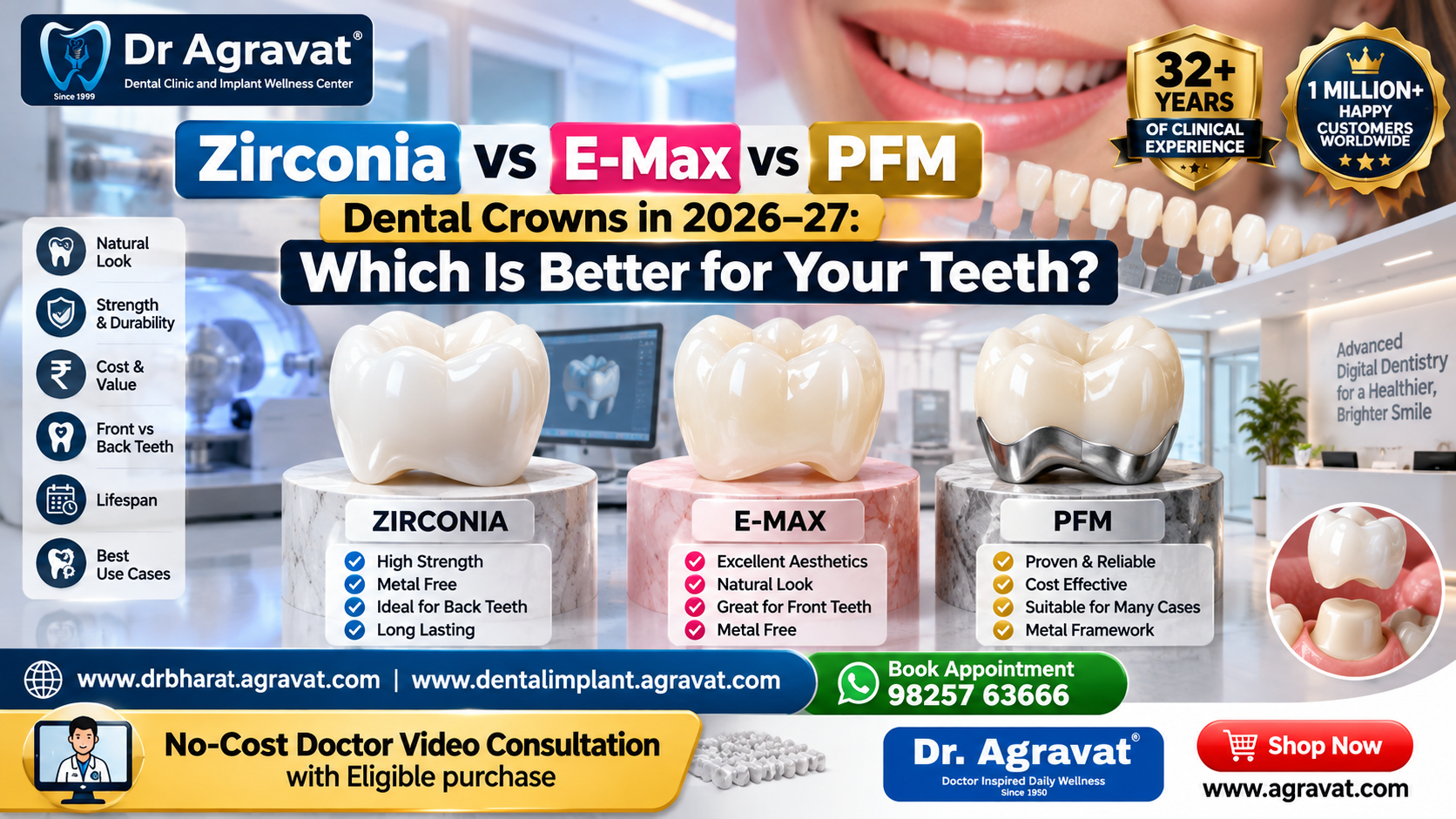
Choosing a crown material is a daily clinical decision: after root canal treatment, on implants and in smile design. This guide from Dr Agravat Dental Implant & Endodontic Academy summarises how to choose between monolithic zirconia, lithium disilicate (E-max) and porcelain-fused-to-metal (PFM), with practical points on preparation, cementation and case selection.
Material overview for clinicians
| Monolithic zirconia | Lithium disilicate (E-max) | PFM | |
|---|---|---|---|
| Material | Zirconium dioxide polycrystal | Glass-ceramic | Metal framework + feldspathic porcelain |
| Aesthetics | Good; better with translucent grades | Excellent | Moderate |
| Fracture resistance | Very high (varies by grade) | High when bonded at adequate thickness | Framework strong; veneer may chip |
| Cementation | Conventional or adhesive (MDP primer) | Adhesive bonding preferred | Conventional |
| Typical indications | Molars, bruxers, implants, low clearance | Anterior and premolar crowns, veneers, onlays | Posterior crowns, budget cases |
| Watch out for | Opposing-tooth wear if poorly polished | Thin sections, poor bonding | Metal margin, chipping |
Preparation essentials
- Zirconia: one of the most conservative full-coverage options; monolithic zirconia tolerates thinner sections than glass-ceramics. A rounded shoulder or chamfer margin is commonly used.
- E-max: needs sufficient, even ceramic thickness and rounded internal angles. Check the manufacturer’s minimum thickness for crowns before preparing.
- PFM: requires space for both metal and porcelain, so reduction is usually greater, especially on the facial surface.
- All materials: smooth, well-defined margins and a clear path of insertion matter more than the material itself.
Cementation and bonding
| Material | Surface treatment | Typical cement |
|---|---|---|
| Zirconia | Air abrasion (as per manufacturer), MDP-containing primer | RMGIC or resin cement |
| Lithium disilicate | Hydrofluoric acid etch, then silane | Adhesive resin cement |
| PFM | Clean and dry; follow lab instructions | GIC, RMGIC or resin cement |
Choosing the material: a quick decision guide
| Clinical situation | Usual first consideration |
|---|---|
| Endodontically treated molar | Monolithic zirconia |
| Anterior crown with high aesthetic demand | Lithium disilicate |
| Bruxism or heavy occlusal forces | Monolithic zirconia, with a night guard |
| Implant-supported single crown | Zirconia (screw- or cement-retained per case) |
| Limited occlusal clearance | Monolithic zirconia |
| Cost-sensitive posterior restoration | PFM |
Crowns after root canal treatment
Most endodontically treated posterior teeth benefit from cuspal coverage. Plan the core, ferrule and crown material at the same time as the root canal. Our root canal training covers this restorative planning: see root canal training for dentists and the EndoDeck single-visit root canal masterclass.
Explaining crown options to patients
- Lead with the tooth’s needs (strength, aesthetics, space), then discuss cost
- Show shade options and, where possible, a digital preview
- Be honest about the limits of each material
- Write the material, warranty terms (if any) and maintenance advice in the treatment plan
Frequently asked questions
When should I choose zirconia over E-max?
Zirconia is usually favoured where strength matters most: molars, patients with heavy bite forces or bruxism, limited occlusal clearance and implant-supported crowns. E-max is usually favoured where aesthetics lead, such as anterior crowns, provided the preparation allows adequate ceramic thickness and adhesive bonding.
Is PFM still a reasonable choice today?
Yes, in selected cases. PFM has a long clinical track record and remains useful for cost-sensitive posterior restorations and some long-span situations. Its limits are aesthetics, possible veneer chipping and a metal margin that may show with recession.
How should zirconia crowns be cemented?
Conventional cements such as resin-modified glass ionomer are commonly used when retention is good. For short or tapered preparations, adhesive cementation with an MDP-containing primer or cement after air abrasion improves retention. Always follow the manufacturer’s instructions for the specific material.
How should E-max crowns be bonded?
Lithium disilicate is typically etched with hydrofluoric acid, silanated and adhesively bonded with resin cement. Correct etching time, clean isolation and good moisture control are critical to long-term success.
Will this be covered in academy courses?
Restorative planning after root canal treatment and on implants is discussed in our endodontic and implantology programmes. Message us on WhatsApp for course dates and content.
Does digital workflow change material choice?
Intraoral scanning and CAD/CAM make zirconia and lithium disilicate restorations efficient to produce, but material selection is still a clinical decision based on the tooth, occlusion, space and aesthetics.
For the patient-facing version of this comparison, see Zirconia vs E-Max vs PFM dental crowns on our main site.
Learn restorative planning with Dr Agravat
Implantology and endodontic courses with one-to-one mentorship in Thaltej, Ahmedabad.
 Dr. Agravat Dental Implant Endodontic AcademyDr Agravat House, beside Satva Complex, opp. NK Farm, Thaltej, Ahmedabad 380059
098257 63666